
Artificial intelligence or AI Virtual Shopping Agents, a cognitive technology, presented the industries with restructuring in terms of user experience and augmented workflow. A similar transformation has been noted in the context of AI agents for virtual shopping assistance. Convenience in terms of shopping experience, being the driver of layman-focused, is associated with the futuristic AI virtual agents.
Considering that the retail businesses are contemplating AI Virtual Shopping Agents and copilots as they enable users to navigate through the selection and buying process, decision makers are making a leap. This leap is what has been driving the boosted sales and building new revenue streams. Since such is the premise, entrepreneurs with revolutionary mindset, like you, are also planning on bringing such automation in retail industry.
As the user end experience is a concern and offering them convenience is your solution, you must apprehend the potential of AI agent in-depth with our bifurcation. This guide on AI virtual shopping agent being revolutionary and worth the investment begins with the comprehending the core of AI.
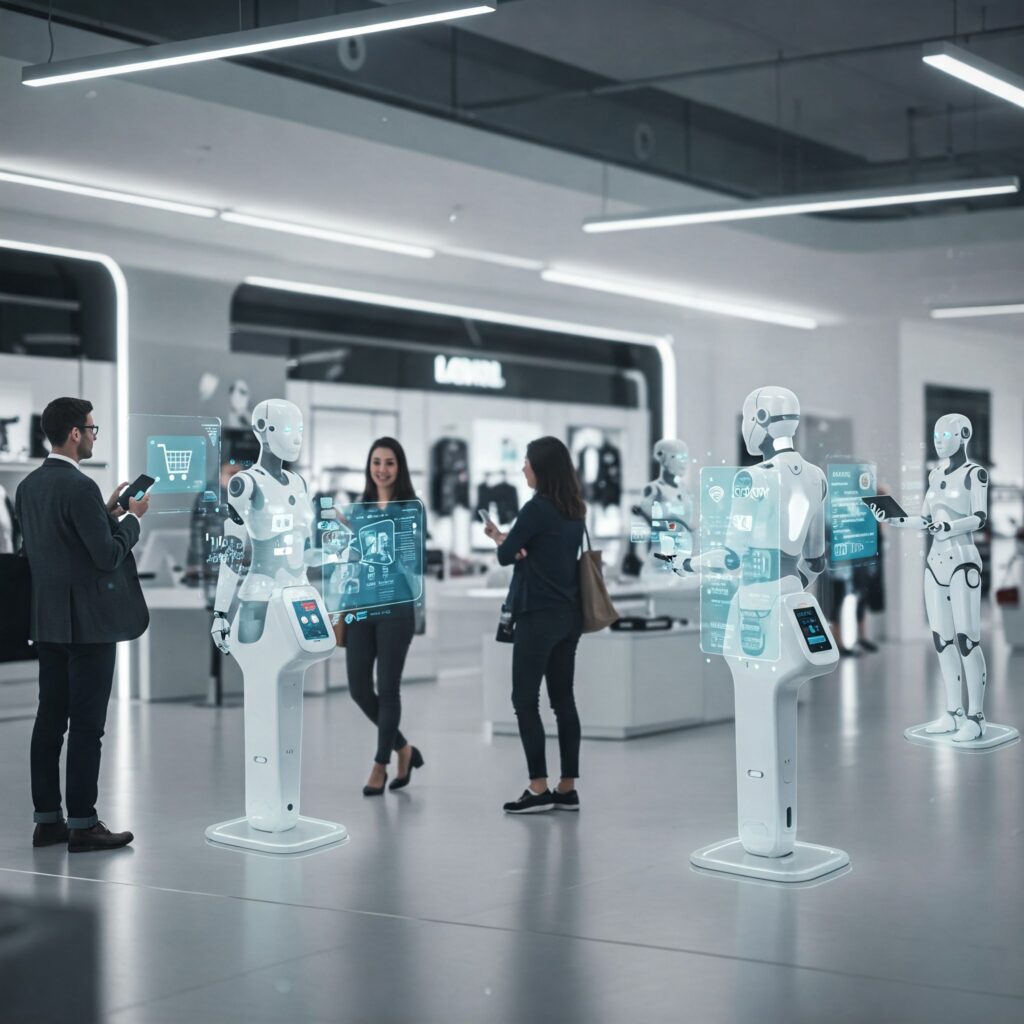
What are AI Agents in the Retail Industry?
The primary concern of many decision-makers lies in the terminology of AI virtual shopping agents and generative AI in the retail industry. To bring it in simple terms, an agent that mimics humans for conversations and actions, like automating tedious tasks. While generative AI is only limited to conversations and content generation, the AI agent assists you in navigating through the website, recommends products based on your reference, and much more.
Coming into practical use is what makes the AI agent a worthy investment to assist users across platforms. To build future-ready solutions powered by intelligent technologies, you can take assistance from an AI agent development company that possesses extensive insights into building user-focused AI agents.
Automation in Retail Industry with AI Agents: Market Overview
Once clear with the AI agent, the value of such solutions in the market becomes imperative for retail-focused decision makers. The question of progressive figures after investment is a criterion that an entrepreneur prefers to assess before making a decision. Not only that, to fixate on the growing market, they also apprehend the highlighted statistics in terms of user inclination and reliance on retail AI agents.
To present the overview of the market, we have listed down a few statistics that can assist you in evaluating the worth of AI virtual Shopping agents in the future-focused times. Take a look at the statistics below.
- A recent report suggested that 70% of retail businesses reflected a 25% acceleration in customer experience and satisfaction.
- These retail and manufacturing businesses also witnessed a 35% reduction in overall costs after implementing AI agents.
- By the end of 2025, the AI agent market is predicted to reach the figure of $150 Bn.
These figures, in the context of the AI integration services, have reflected market value elevation. Since the graph appears to increase over the years, it is safe to say that AI agent will be an investment-worthy decision for a retail business.
Different Types of AI Virtual Shopping Agents
Considering that you must make a decision in favor of an AI virtual shopping agent, it is imperative to get fully informed about the types and how they assist you in modernizing the user experience. As different retail businesses have diverse needs, the agents come in different types when planning on AI agent development. To align your needs with the types and offer a comprehensive idea of distinction, the table below can assist you in decision-making.
| Type | What Function Do They Do | Key Features |
| Chatbots & Assistants | Text-based help on sites or apps | Instant replies, 24/7 support, FAQs |
| Voice AI Agents | Voice-enabled shopping via smart devices | Voice search, hands-free, NLP |
| AI Personal Shopper | Suggests products based on user behavior | Personalized picks, upsell, cross-sell |
| AI Customer Service Agent | Handles queries and support tasks | Order help, issue resolution, and smart routing |
Real-World Use Cases of AI Agents in the Retail Industry
Now that we have understood the distinction between the types of AI Shopping agents, it is time to understand their real-world use cases. The applications of AI virtual shopping agents that are making a difference are imperative to bring the solutions to use and augment the overall workflow and user experience. For instance, AI agents can be utilized for analyzing the upcoming trends and optimizing product prices based on the market.
Considering that these use cases are significant for AI agent strategies, let us understand them in depth.
1. Product Recommendation
AI agents for retail analyze the user data and predict patterns in terms of product recommendations. These intelligent solutions process the user’s history to present the possible products they might need and recommend them for probable purchase.
2. Market Research and Analysis
To talk in terms of retail businesses, these AI agents/AI virtual shopping agents collect available data and assess the market trends on social media to bring forth an analysis to target the users. The retail businesses can modify their solutions, update their inventory, or target their audience based on the current market preference.
3. Automated Customer Support
Among the popular use cases, customer support automation in retail industry is dependent on AI virtual shopping agents. These agents serve as 24/7 customer support to users and offer them speedy issue resolution services to augment their shopping experience in terms of buying, returns, or exchanges.
4. Trend Forecasting
As we have mentioned above, the AI agent collects the data and brings forth market-focused insights. These insights enable the retail businesses to make decisions for upcoming trends and plan ahead to boost their revenue generation opportunities.
5. Dynamic Price Strategies
Another use case of AI integration services is that they build solutions that assist manufacturing businesses in staying ahead of their competitors. These solutions monitor the product pricing across the competitor platforms and adjust it as per the market to drive users and match the competitive pricing with dynamic strategies.
6. Voice-Based Search Optimization
AI agents are proving to be an asset in the voice-based shopping experiences. These agents respond to the voice command, interpret it, and bring forth the results to the user with a hands-free experience across the retail business’s website. This way, the user finds it convenient to locate a certain product.
Significant Benefits of Retail AI Agent Development for Driving Tangible Results
As we approach the end and have grasped the technical aspects of AI agent development, let us move on to the benefits-focused discussion. The advantages of AI agent integration solidify entrepreneurs’ decisions. This way, they have a conclusive idea of the impact AI agents have on business workflow and user experience.
1. Data-Driven Insights
AI agents for the retail industry assist businesses in taking data-driven decisions with valuable user-focused insights that enable the modification of experiences. Not only that, but manufacturing businesses can analyze the market, monitor insights, and include revenue-driven strategies.
2. Autonomous Supply Networks
When the automation in retail industry is talked about, the attuning of autonomous supply networks is appraised. The AI agents restructure the supply chain system as per the market trends and user demands to automate the inventory decisions and make product-based stock decisions.
3. Personalized Shopping Experience
As we have mentioned above, the product recommendations and suggestions work based on individual users’ preferences. This way, the retail industry is personalizing the shopping experience and bringing products to users that they are looking for.
4. Business Process Automation
AI agents are changing the business processing with automation in retail industry. Making the sector reliant on intelligent technology and elimination the need for menial labour is coming to an end with the assistance of AI agents and business automation.
5. Enhanced Customer Engagement
An AI-powered customer support and service system engages the users and offers them layman-focused solutions within minutes. The days are gone when users preferred hours to get their issues resolved on retail websites. Nowadays, minutes for a solution is the approach that transcends business value and builds trust.
Conclusion
As we wind up the guide on the revolution, AI agents are welcomed for the retail industry; it is evident that businesses must make a decision that enables them to drive tangible results. AI agents are among the solutions that are bringing change to the industry and leading it to automation for users and workflow.





0 Comments